
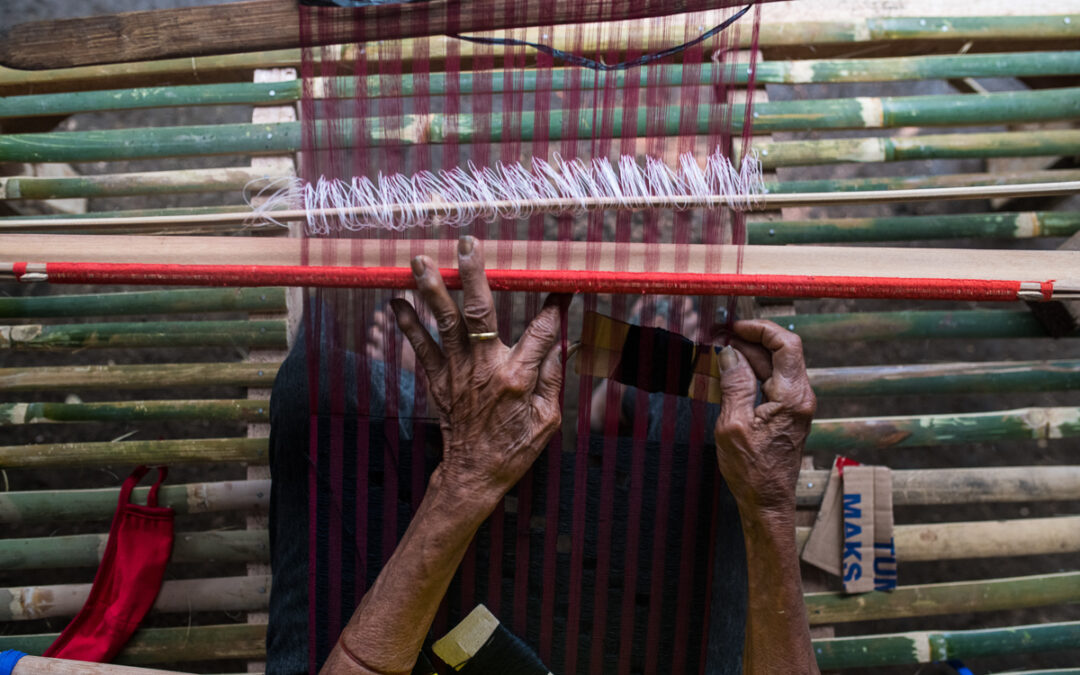
Stephanie Brookes writes about Pejeng Kangin, a resilient Balinese weaving village just outside Ubud that has united the weavers of Bali and helped revive a long-lost artisan craft.
The weavers of Bali are dusting off their looms. A long-forgotten artisan craft is coming back to a small village just outside Ubud, Bali, Indonesia. Around 25 years ago, in Pejeng Kangin Village, the women were spinning cotton, dyeing with natural dyes, and click-clacking away on their looms every day. However, with the advent of tourism hitting Bali in the 80s and 90s, many young people went to Tourism School. They gravitated towards hotel and restaurant work and simply left their looms and craft behind. Putu was one of these people, “I learnt to weave when I was eight years old,” she said, “But because of economic reality, a job in tourism paid a lot more than weaving. I got busy working full time in the tourism industry, raising three boys, plus my farming duties and had no spare time for weaving.”
Often, a leader emerges. Putu indeed emerged and found a way to get the weavers back on the looms. A plan was hatched with the head of the village and a couple of local ex-pats who lived there. A fund was established during the time of COVID called The Togetherness Project, and a successful international donation campaign kicked off to buy more looms and the raw product: reels of cotton from the market.
Weaving

Putu knew from the elders in the village that one of the weavers used to make handwoven silk and cotton brocade for the daughter of Suharto (President of Indonesia 1967-1998). Putu found the master weaver, Ibu Agung and also discovered Ibu Klemik and Apel Murtini. There were not just one but three very gifted and talented weavers in the village. There was agreement that the women would share their weaving skills and knowledge with other women in the village and teach the young ones, and the plan went into action. Olthen d looms reappeared from hidden corners and saw the light of day yet again.
Once the word spread, several local women showed interest, and the Pejeng Kangin weavers united again. With donations, additional looms were acquired, the art of natural dyeing was revived, and regular trips to the Klungkung market were made for silk and cotton thread. Just two weeks later, Pejeng Kangin had re-established its ikat cottage industry. Twelve women were weaving six days a week, clacking away on their looms. Now, some eighteen months later, there are 35 weavers who are busy on the looms. They even dance the Tenun (weaving) Dance regularly at special ceremonies now.

Putu was already heading up the Village Women’s Rice Community (KWT Manik Mertasari) but happily took on the new role of leader of the weaving circle. She came up with a novel idea. If you want an ikat, you are asked to “pay it forward” at the time of ordering, so the weavers can buy the materials they need to get started. Putu also encourages personal contact with the customer and sends photos and videos as the specific ikat progresses. Your ikat can even be designed with your own special motif. You just need to send a photo and the weavers, who are so masterfully skilled, can make your shawl or bed runner to order, with your own design.
Once completed, your ikat (a table runner, sarong, shawl or wall hanging) can be shipped to you.

Putu now runs a thriving cooking school at www.ubudvillageplate.com, which connects tourists with local families. As Putu explained, “For me, weaving is a passion, and so is food. I love to cook delicious local dishes for travellers. Food is culture, plus it brings people to our home.”


Local Food Packages
At the time of COVID, another project launched with the help of the Village Leader, Made Astawa and along with donations, and The Togetherness Project, people were cooking for others who were in need. The Banjar was delivering 170 packs of rice, noodles, cooking oil and eggs to every household weekly. Twenty local volunteers went out on foot with a list, ticking off every home that needed help and leaving no one out. “That is very important,” said Made, “If we give to one, we give to all. We live by adat (traditional) law, and this is our way”.
Outreach Packages
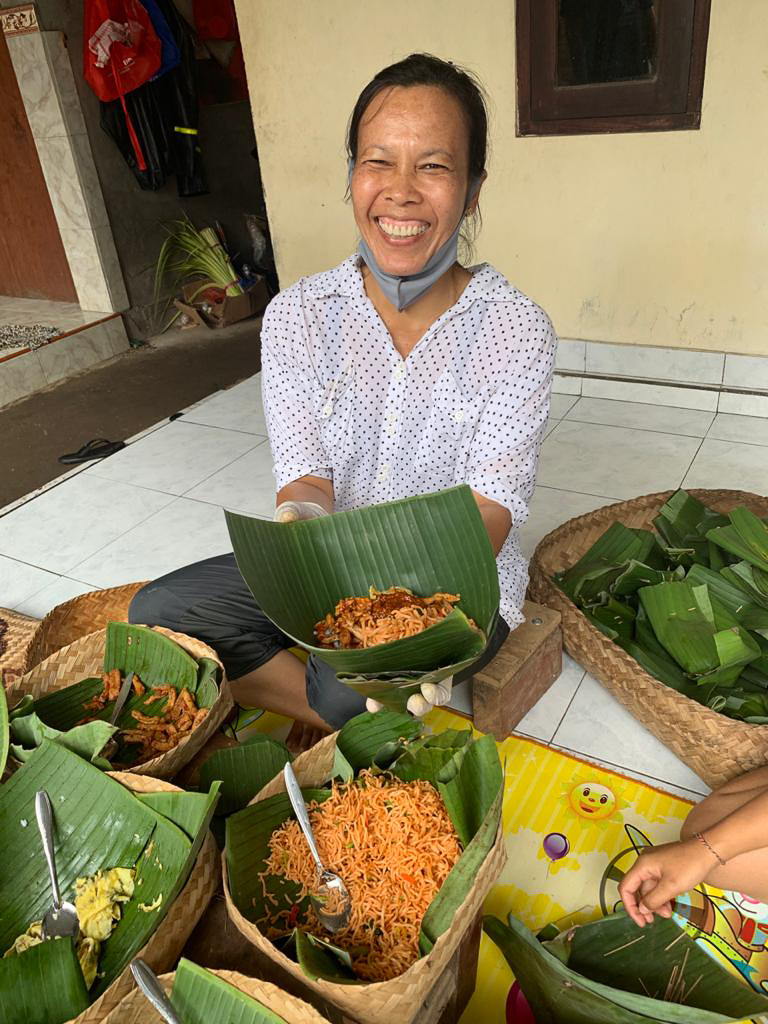
Working with Bali Crisis Kitchen and Scholars for Sustenance, the village employed 44 cooks. They made up 100 fresh food packs every day. These were hand-delivered to Indonesians under challenging circumstances in makeshift shacks and kos (boarding) accommodation or on the streets in Kuta and Denpasar. During COVID, many people lost their jobs in tourism or construction and had no means of renting housing with a kitchen to cook in. In fact, they cannot even afford one nourishing meal a day, and many literally ran out of savings.
Many of these workers were from Java, Sumba, Flores, Papua, and other islands and could not return to their villages. They relied on community projects to survive.
How can I help?
The weavers need orders.
Please consider ordering a beautiful hand-crafted ikat. You can be part of the solution and help keep this cottage industry alive, which aligns with strong artisan and cultural significance and benefits. By purchasing a beautiful hand-crafted piece, you help keep the ancient knowledge of weaving honoured and, most importantly, inspire the younger generation of women weavers.
Story by Stephanie Brookes: www.travelwriter.ws
Book a cooking class, order a woven Ikat, or book a local walking village tour: www.togethernessproject.net
Local Balinese Interviews: YouTube interview channel
Weaving orders: Please order your scarf, sarong, table runner, set of placemats, ikat, wall hanging or bed runner through the website.
Head of Banjar Pesalakan – Made Astawa: WA +62 812 3960 3177. Email: madeastawa83@gmail.com
Local Pejeng Kangin Homestay Accommodation: Phone Made Astawa or book www.togethernessproject.net
Published Garland Magazine: July 2020
Updated March, 2026

