
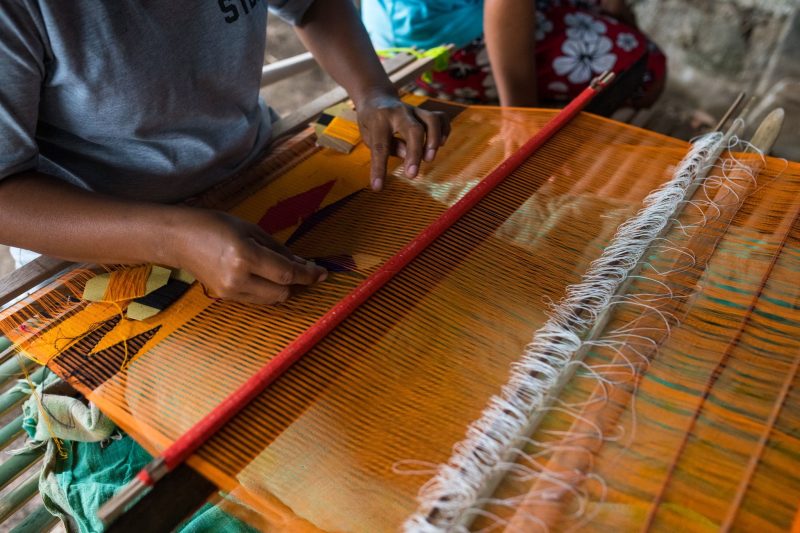
Stephanie Brookes writes about Pejeng Kangin, a resilient weaving village just outside Ubud that has united the weavers of Bali and helped revive a long-lost artisan craft.
Pejeng Kangin Village, located 7 kms from Ubud, has always been a weaving village. The craft was lost in the 80s and 90s with the advent of tourism and the lure of jobs in the industry. Now, there has been a resurgence, and women are spinning cotton again, dyeing with natural dyes, and click-clacking away on their looms every day. Putu was a former weaver who left her craft to work at a hotel. “I learned to weave when I was eight years old,” she said, “but because of economic reality, a job in tourism paid a lot more than weaving. I got busy working full time in the tourism industry, raising three boys, plus my farming duties and had no spare time for weaving.”
When COVID hit in 2020, everything changed. Often, a leader emerges in times of hardship, and Putu, out of work like many, found a way to get back on her loom and motivate 35 other women to take up the skill as well. The motivation to revitalise weaving in the village was directly related to COVID. Many people in the village were out of work as Bali closed its international airport and the Visa on Arrival (VOA) stopped in March 2020. Around 80 per cent of the workforce employed in tourism no longer had gainful employment. A plan was hatched with the head of the village, Made Astawa, and a couple of local expats, to reignite interest in the local weaving traditions. The Togetherness Project was set up, and a donation campaign was launched to purchase new looms and cotton reels.
Weaving
Putu learned from the village elders that one of the weavers used to make handwoven silk and cotton brocade for the daughter of Suharto, the former President of Indonesia from 1967 to 1998. Putu found the master weaver, Ibu Agung, and also discovered Ibu Klemik and Apel Murtini. There were not just one but three very talented weavers in this tiny village. There was an agreement that the women would share their weaving skills and knowledge with other women in the village and teach the young ones, and a plan went into action. All because of COVID and the resourcefulness of these village women, those old looms reappeared from hidden corners and saw the light of day again.
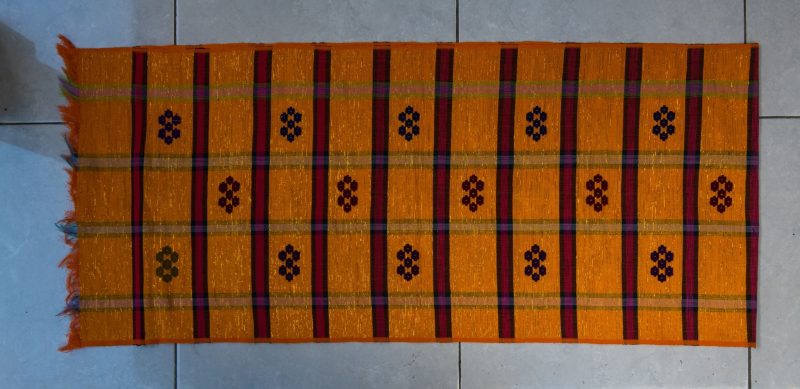
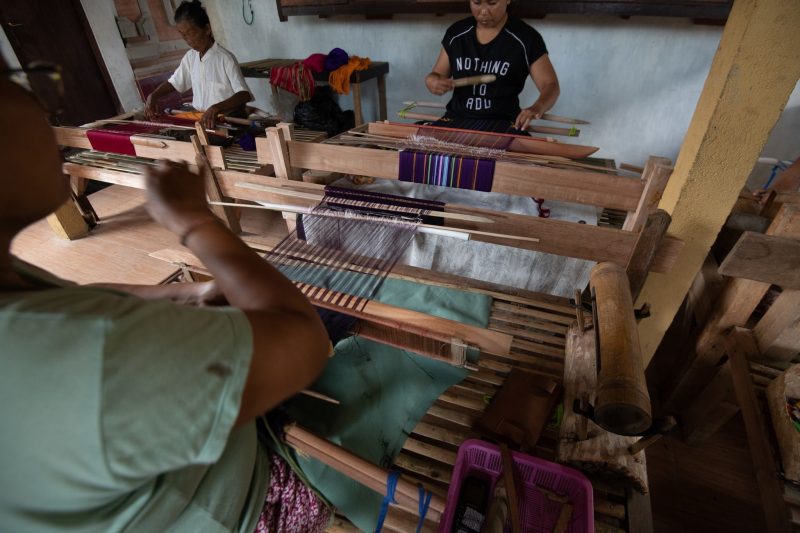
Once the word spread, several local women showed interest, and the Pejeng Kangin weavers united again. With donations, additional looms were acquired, the art of natural dyeing was revived, and regular trips to the Klungkung market were made for silk and cotton thread. Within no time, Pejeng Kangin had re-established its ikat cottage industry.
Today, many orders are coming in, and many customers are requesting natural dyes. Back to the old ways, yet again. Plants are now used to make natural dyes. Everything is there in the village: Mango leaves (yellow), cacao leaves (grey), banana leaves (green), Secang wood (red), and the favourite of all, indigo leaves (blue).
Initially, 12 women were weaving six days a week, clacking away on their new looms, and now 35 weavers are busy on the looms. The village even revitalised their dance, the Tenun (weaving) Dance, so there was a dance revival as well as an artisan craft revival!
Putu was already head of the Village Women’s Rice Community (KWT Manik Mertasari) and happily took on the new role of leader of the Women’s Weaving Circle. She came up with a novel idea. A customer can design their own unique motif! You just need to provide a photo, and she will assign one of the more experienced, masterful weavers to make your shawl, set of placemats, rug or bed runner with your own design. Once completed, your ikat (woven piece) can be shipped to you.
The village has now initiated weaving classes. Even more innovation. Would you like to learn to weave? Now you can come to the village, join a class and weave your own piece. Another new offering is the very popular cultural village tour. This is led by local historian and Banjar Leader, Made Astawa. The community has now developed an education centre and permaculture garden, and you can tour the organic farm. Once a month, the village hosts a thriving Sunday Organic Market day from 9.00 am to 12.00 am. Get your fresh fruit and vegetables, local honey, eggs and meet the weavers and the women farmers.
Cooking School
In addition to the weaving enterprise, you can also take a cooking lesson at a Balinese home and learn about food and culture. Taking a cooking class in Ubud has always been among the top 10 things to do, so this traditional village now offers a full cooking experience, allowing you to connect with Balinese culture through food.
By visiting Pejeng Kangin village, you can help keep the ancient knowledge of traditional weaving honoured, and participate in daily village life through a host of activities.
Fact File
Pejeng Kangin weaving classes, cooking classes, weaving shop and village tours can be arranged: www.togethernessproject.net
Homestay Accommodation: Made Astawa, WA +62 812 3960 3177. Email: madeastawa83@gmail.com
Stephanie Brookes is a travel writer and blogger with tales from Indonesia and beyond.
www.travelwriter.ws
http://www.facebook.com/stephtravelwriter
www.instagram.com/stephtravelwriter
Author –“Indonesia’s Hidden Heritage: Cultural Journeys of Discovery”
Published in Indonesia Expat Magazine
Updated February 2026

