
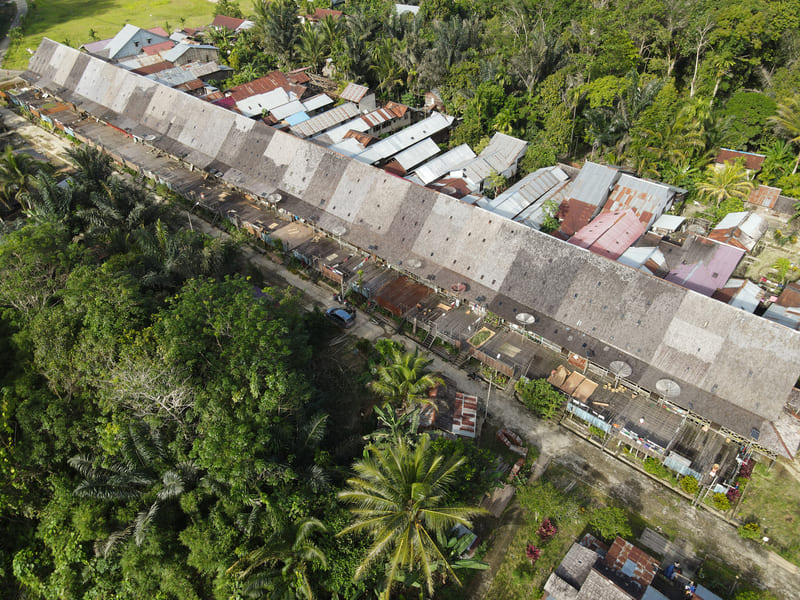
When I entered Sungai Utik Village, in the heart of West Kalimantan, I felt very excited when I caught my first glance at the longhouse.
This long wooden communal dwelling, with a single roof stretching 214 metres, houses 293 people. A delegation of young Dayak Iban dancers was anxiously waiting at the village’s front entrance, their glittery headpieces catching the afternoon light. A few nervous giggles followed, and the girls motioned for me to follow them to their very longhouse.

With a tinkling of anklets and sweet voices serenading me, I was led to the front entrance, where I ascended a long, ancient, ironwood single-log staircase with carved steps. As I entered the longhouse, I was instructed to take some of the creamy white drink (Ijuk) handed to me and promptly spilled some on the floor. I was told this was for the ancestors, and the rest was for me to drink during the welcome guest ritual.
The longhouse residents sat on the wooden floorboards with beaming, welcoming smiles, and I immediately felt comfortable and warmly welcomed.
Next, Bandi, the Dayak Iban village elder, began the welcoming guest ritual. The ceremony cleans the energy that people bring in from the outside, and then I was blessed. The ritual provides safety and protection from the ancestor’s spirit and allows for good energy while a guest stays in the longhouse.

I was mesmerised by Bandi’s tattoo motifs. I could not take my eyes off them, especially the flowers adorning the top of his shoulders and the intricate symbols tattooed on his hands. His back, chest, and neck were also tattooed. Tattooing is an essential part of male tradition, with motifs on the shoulders symbolising strength and protection.
The ritual continued with a live chicken being raised in the air and Bandi reciting chants. Then the dancing started. I watched the girls move with a gentle, calm flow, moving in time to the beat of the music. Next, afternoon tea was served. A delicious array of miniature rice flour pancakes, strong coffee, and that milky drink again. Bandi explained to us that the liquid was tapped from the Ijuk tree every day, after which a piece of bark was added to aid fermentation, thereby making it alcoholic. It tasted wonderful and seemed to be only mildly intoxicating. However, I erred on the side of caution and took only small sips.
“You can call me Apay Janggut,” Bandi said. “That means the bearded one,” he said with a chuckle, pulling on his long white beard. “After you rest, you may go to the river and swim, but be careful because once you swim in our river, you will be captivated and always wish to return to our home, Sungai Utik,” he said with a confident wide smile.
It was very reassuring to learn that my invitation to visit this lovely community had already become an invitation to return, and I had only just arrived! That is the way of the Dayak Iban – hospitality plus.

Next, I was shown to my homestay room. Surprisingly, it was very modern inside and more than just a room. The living quarters consisted of a large formal lounge, two guest rooms, a second lounge, a bathroom, an upper-level storage area, and a western toilet. It also had a TV and a washing machine. Very well-appointed digs. The 28 doors that stretched the length of the longhouse provided a private dwelling for each family with the same room configuration. Adjoining the kitchen was an outdoor deck – a gathering place for friendly, social “5 pm office meetings”, always accompanied by Ijuk.
Over the next three days, the river became my favourite place. In the late afternoon, it became a playground for the village kids, who leapt from rocks, clung to vines, and played tag, jump rope, and swing games. It was the most entertaining and lively scene, mostly without adult supervision.

The beautiful forests surrounding the river and Sungai Utik’s land are now protected. Bandi told me this had involved a legal battle, won with the help of AMAN (Indigenous People’s Alliance of the Archipelago), who represented and supported Sungai Utik’s case for legal recognition of their forest boundaries.
“I cannot read,” Bandi said, “but I got help from AMAN, and we now have the legal title and protection of our forests. This is very important to us. It means the title to our destiny. The sign at the front of our village displays the details of our legal title for all to see. No one can take it from us now.”
He explained that the battle to protect these lands went back a long way. In 1979, a corporation was licensed to develop the land in Sungai Utik’s customary forest. The company tried to harvest wood but faced resistance from the locals. In 1998, with the help of NGOs, including AMAN, the forests were mapped, and ownership of their land was secured.
Sleeping in the longhouse and living with the Dayak Iban was a cultural awakening for me on many levels. I took an overnight trip into the forest with Bandi, took walks to the rice field daily with the kids, met the farmers, and was invited to sit in their rice house out in the fields and talk about village life.

It was a delight to feel accepted and welcomed into village life and to discover more about the Dayak Iban world and its relationship with the forests. On my forest walks, my village guide pointed out various medicinal plants, such as the Kedadai leaf, which can be ground into a medicine for breastfeeding mothers to improve their milk supply, and the Raru bark, which cures stomachaches. In a true community way, care of the forest and the river is taken on by a different family every month. This way, everyone in the village actively bears this responsibility.
The Sungai Utik’s customary forest covers 10,087.4 hectares, and the protected forest is 9,480 hectares. The rest is used to cultivate orchards, crops, rubber plantations, and swidden fields. The entire village lives in sync with the land through subsistence hunting, growing crops, and gathering food and medicine from the forest. The Iban are foresters and protect their trees, taking only what they need to build or repair a house. Under adat law, it is traditional that no trees can be cut for commercial gain.
Living in a longhouse allowed me to participate in a traditional way of life that is increasingly rare today.
Story by Stephanie Brookes
Photography: Kynan Tegar
Updated Aug 2026. Published in Indonesia Expat May 2023
How to Get There: Fly direct from Jakarta or from multiple cities (from Bali, transit through Surabaya) to Pontianak, West Kalimantan, and then connect with a domestic flight to Putussibau. It takes around 1.5 hours to reach Sungai Utik Village.
Tour arrangements: send me an email at stephtravelwriter@gmail.com, and I will provide you with a specialised itinerary including places of interest, opportunities to engage with local culture, and unique offerings.

